
You don't need a better story. You need to tell yours better.
CVBro scores your real experience against every job you're chasing — the same way an ATS actually reads it — then helps you say it clearly. No invented skills. No surprises in the interview.
Most resume tools promise to make you look better. We think that's the wrong promise. CVBro was born from 150+ applications in one year and a lesson learned the hard way: an exaggerated resume doesn't get you more interviews — and if you do land one, it becomes a problem the moment you sit down across from a human. What you need is the truth about your fit — for every job on your list, before you apply to any of them.
Getting hired is broken. On both sides of the table.
Apply to a job and within two days you're one of a hundred applicants. Sometimes one of five hundred. Recruiters can't read that pile; candidates can't stand out in it. Both sides turn to volume — everyone works harder, and no one gets closer.
Then AI arrived, and mostly made it worse: the new generation of resume tools optimizes for one thing — a higher score — even when getting there means skills you can't defend and words you'd never say out loud. That's not optimization: it's an arms race of noise, paid for by the honest candidates buried in the pile and the recruiters trying to find them.
CVBro exists for both of them.
For Candidates
Know which of your target jobs genuinely fit your experience — all of them at once, before you spend a minute applying — and present your real accomplishments so clearly that they can't be missed.
For Recruiters
Fewer, more targeted applications from CVBro users — and the ones that do land are the applications that survive the interview, because nothing in them was invented.
We believe the fix for a noisy system isn't louder noise. It's better signal.
It started with 150 applications and one very bad day.
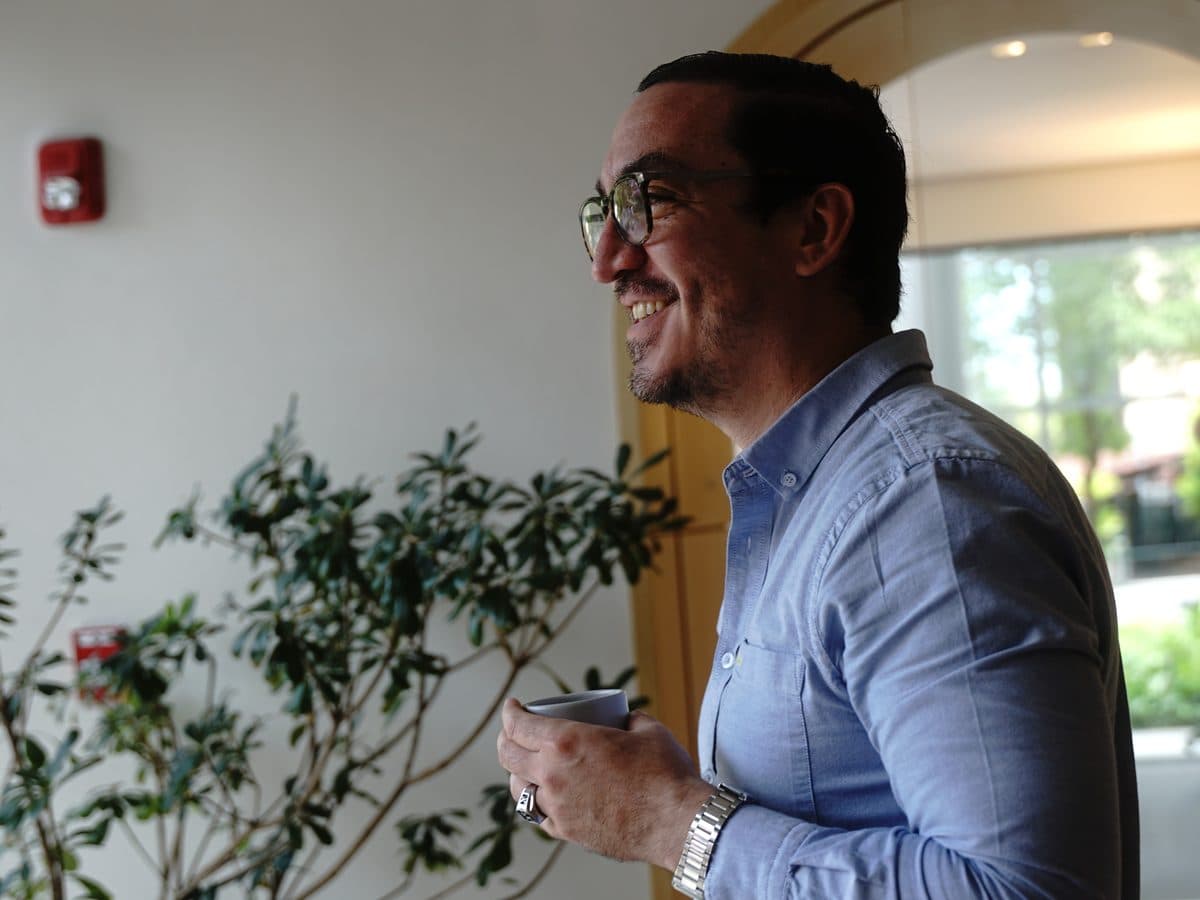
“It was still me.”
— Gabriel, founder
The same professional, in a well-tailored suit — the line that decided what CVBro would and wouldn't do.
Our founder, Gabriel, spent his career in finance and strategy — Fitch Ratings, Citigroup, Dell, Sanofi, Alquería, Adidas. On paper, exactly the kind of profile that isn't supposed to struggle. Then he spent twelve months looking for his next role, and learned what "on paper" is worth.
Here's how he tells it:
“More than 150 applications. Transition coaches. A rebuilt LinkedIn profile. I studied modern recruiting the way I'd study any market. And still, mostly, silence.”
“There was one specific day when I stopped believing the problem was my resume and started believing the problem was me. That I wasn't meant to have a job at all — that all of that effort simply had no return. If you've run a long search, you know that day. Most people never talk about it.”
“What pulled me out wasn't a breakthrough. It was persistence — and then one ordinary morning, a very unromantic thought: I've done this by hand 150 times. There has to be a better way.”
“Be a sniper, not a spray gun” is good advice — precision beats volume. But a sniper never pulls the trigger without knowing the distance, and that's exactly what CVBro gives you: your real match with every job, measured before you spend a single evening applying. Every attempt becomes a calculated shot, not a shot in the dark.
Gabriel and his advisors lived through every generation of the tailoring problem: Word documents edited one at a time, then ChatGPT, then the specialized optimizers. Each generation faster than the last. None more honest.
And speed was the trap. One tool rewrote his profile as a “supply chain expert” because his strategy work had brushed against it. He was applying to so many jobs at once that he never noticed. A hiring manager did — and Gabriel spent part of that interview carefully talking his own resume back down to the truth. He handled it well; he still didn't get the role.
An honest tool would have told him that before he applied.
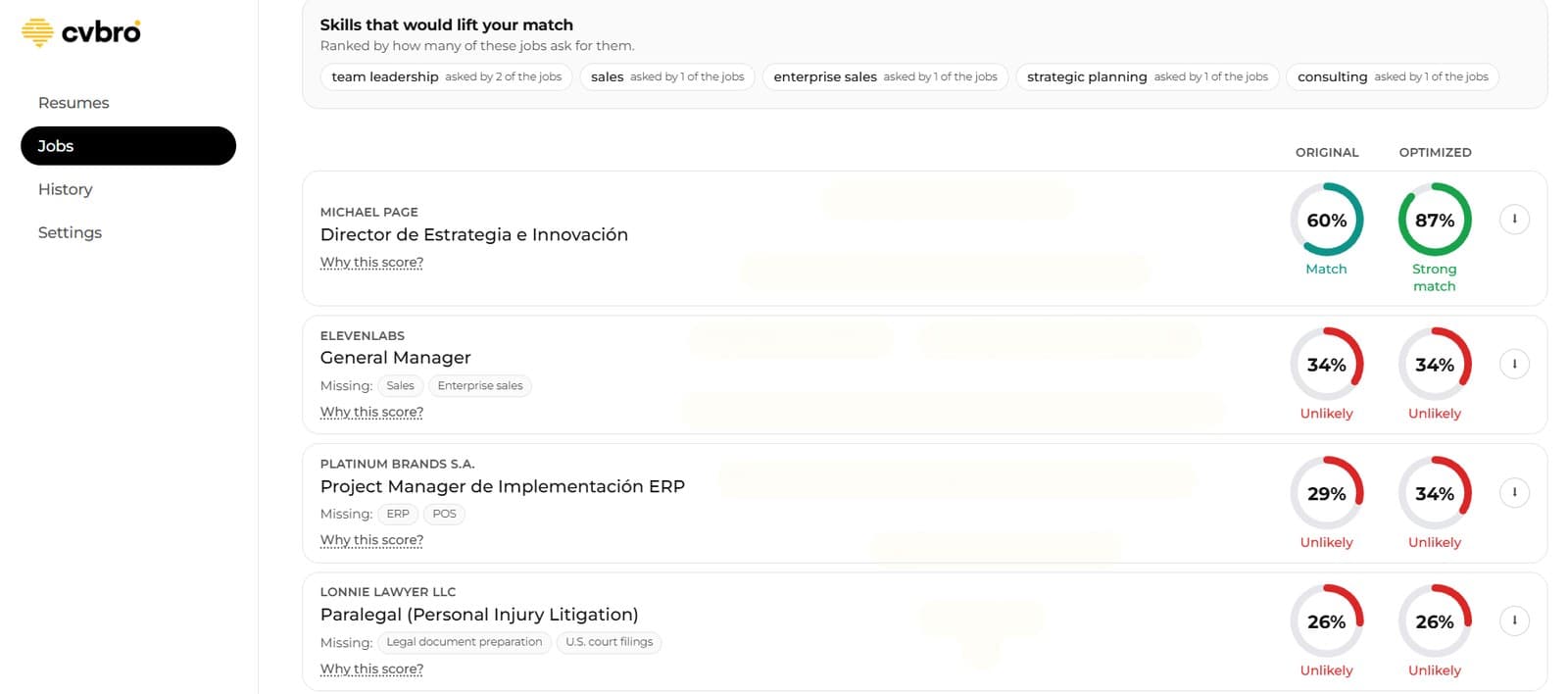
The confirmation came as an experiment: he fed a legal role — nowhere near his background — into a leading optimizer, and it came back with a glowing match score. A tool that flatters you when you clearly don't fit can't be trusted when it says you do. That day he stopped trusting the whole category.
So he built the tool he'd needed all along, and tested it head-to-head against that optimizer — same job, same resume, run through both. One result came back polished, with fancy words that weren't quite true. The other came from his own engine: simpler, but real. In his words:
“It was still me.”
That's the standard everything at CVBro is built against: scores come from fixed, transparent rules, not an AI's opinion — the same resume and the same job always produce the same result. If a job doesn't fit, the score will say so. If it goes up, you can trust it, because nothing was invented.
What we believe
AI should amplify truth, not invent it.
Our AI finds the strongest evidence already in your experience and helps you say it clearly. It will never add a skill you don't have.
A low score is a gift.
A tool that never says "this job isn't for you" can't be trusted when it says "this one is." Honest scores are what make the good news mean something.
Scoring is math, not mood.
Match scores at CVBro come from fixed, transparent rules — the same inputs always produce the same score. We don't ask an AI to guess a number, because a score you can't reproduce is a score you can't trust.
Your time is the scarcest thing in your search.
Every application to the wrong job costs hours you'll never see again — and every interview slot spent on a bad fit is one an honest fit didn't get. Knowing where you stand before you apply is the biggest time-saver in hiring.
Recruiters aren't the enemy. They're drowning too.
Five hundred applicants per role isn't a candidate problem or a recruiter problem — it's a workflow problem. When candidates self-assess honestly before applying, the pile shrinks and improves at the same time. Both sides win from the same action.
Clarity beats keywords.
ATS compatibility matters, and we handle it. But no keyword ever survived an interview. Clear evidence of real accomplishments does. We make resumes ATS-readable, never ATS-deceptive.
Where this is going.
We're building CVBro from Latin America outward — in Spanish, Portuguese, and English from day one — because the most underserved job seekers of the AI era apply across borders and languages. The plan: become the tool this region trusts with its careers, then take that standard to the world.
Five years from now, here's the change we're working toward: no one applies blind. Before spending a single evening on an application, every candidate knows their real odds — not a flattering estimate — for every job on their list.
And something bigger happens along the way: when candidates can honestly assess fit before applying, the pile of five hundred applications sharpens itself — filtered from the candidate's side, by candor instead of gatekeeping. The distance between a good candidate and the recruiter looking for exactly that person gets shorter every year.
That's the version of hiring we want to hand to the next person who's on application 150: one where effort has a return, evidence beats noise, and the truth — told well — is the best strategy available.
“Know your odds before you move a finger.”
Find out where you really stand. It's free to start.
Upload your resume. Add the jobs you're actually considering. In minutes, you'll know which ones genuinely fit, which are long shots, and exactly what to improve — using only experience you already have.
No invented skills. No tricks you'll have to defend later. Just your strongest, truest resume — for every job at once.